Design Considerations for Heat Pump Cycles
Summary
The Carnot coefficient of performance is often presented as the fundamental upper bound on heat pump efficiency. While thermodynamically correct, this bound is attained only in the limit of vanishing heating capacity. In practice, heat pumps operate under the opposite constraint: the heating rate is specified in advance, while finite heat exchangers require the temperatures at which heat is absorbed and rejected to adjust to sustain that rate.
This post derives the maximum achievable coefficient of performance for an idealized heat pump operating at a specified, nonzero heating capacity, explicitly accounting for finite heat transfer on both the hot and cold sides. The cycle is assumed internally reversible, with all irreversibility attributed to finite-rate heat exchange with external streams. Under these assumptions, a closed-form performance bound is obtained that reduces to the Carnot limit only as the heating rate tends to zero. This construction isolates the thermodynamic consequences of finite heat transfer and makes explicit the tradeoff between efficiency and capacity that is obscured when Carnot performance is treated as a general design target.
The resulting bound preserves a Carnot-like structure but introduces an additive temperature penalty proportional to the heating rate and the total thermal resistance of the heat exchangers. As heating capacity increases under fixed heat exchanger capability, the maximum achievable COP decreases monotonically and approaches unit in the large-capacity limit. Maximizing COP at fixed heating rate is shown to be exactly equivalent to minimizing entropy generation, without invoking linearization or small-temperature-difference assumptions.
Finally, under a fixed total heat exchanger capability constraint, the COP-maximizing allocation is symmetric: the hot-side and cold-side heat exchangers should be sized equally, despite their asymmetric thermodynamic roles. This result mirrors earlier findings for refrigeration cycles and provides a simple, robust design rule that emerges directly from finite-capacity thermodynamics.
1. Introduction
The coefficient of performance of a heat pump is conventionally introduced through its Carnot limit, \[\begin{equation} \mathrm{COP}_\mathrm{hp}^\mathrm{Carnot} = \frac{T_H}{T_H - T_L}. \label{eq:carnot_cop} \end{equation}\]
This expression follows directly from equilibrium thermodynamics and provides a well-defined upper bound for a reversible cycle operating between two reservoirs. It is often presented, implicitly or explicitly, as a general design target.
What is less often emphasized is the condition under which this bound is attained. It corresponds to a limiting case in which heat is transferred across vanishing temperature differences, so that entropy generation associated with heat exchange is zero. In this limit, however, the rate of heat transfer also vanishes. In other words, operating at the Carnot COP implies a vanishingly small heating capacity, yielding a heat pump that is thermodynamically perfect yet practically useless.
This distinction matters because practical heat pump operation is governed by the opposite constraint. In real systems, the heating rate is specified in advance by the load. The temperatures at which heat is absorbed and rejected are not fixed; they must adjust to accommodate that rate using finite heat exchangers. Once the heating capacity is prescribed, finite temperature differences become unavoidable, and Carnot performance is no longer accessible.
Framed this way, the relevant design question is not “how close can we get to the Carnot COP?” but rather: what is the maximum achievable COP for a specified heating rate, given finite heat transfer capability on both the hot and cold sides of the machine? When the heating rate is fixed, the temperature differences required to sustain it become part of the thermodynamic constraint, and they impose an upper bound on performance that depends explicitly on capacity.
This perspective is not new. Klein addressed the analogous problem for refrigeration cycles, deriving the maximum COP achievable at a specified cooling load subject to finite heat exchanger size [1]. He showed that the Carnot COP is recovered only in the limit of vanishing cooling capacity, and that finite heat transfer imposes a tradeoff between efficiency and capacity. The present work extends this framework to heat pumps, where the useful effect is heat delivery rather than heat extraction. While the mathematical structure is closely related, the interpretation of the results for heat pumps warrants separate discussion.
To isolate the consequences of finite heat transfer, the heat pump cycle considered here is intentionally idealized. The working-fluid cycle is assumed internally reversible, and all irreversibility is attributed to finite-rate heat transfer to external streams. This construction strips away component-level losses and focuses attention on the thermodynamic cost of moving heat at a finite rate using finite-sized heat exchangers. Within this framework, several results follow directly. Carnot performance appears as a singular, zero-capacity limit. As heating capacity increases under fixed heat exchanger capability, the maximum COP decreases monotonically and approaches unity. The operating point that maximizes COP coincides exactly with the operating point that minimizes entropy generation. Finally, when total heat exchanger capability is fixed, COP-maximizing allocation is symmetric: the hot-side and cold-side heat exchangers should be sized equally.
2. Model and assumptions
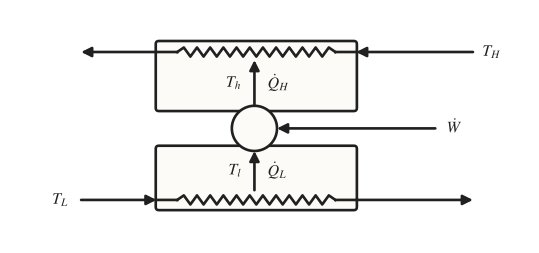
The simplest model capable of capturing the tradeoff between heating capacity and efficiency is constructed. A heat pump operating between two external streams is considered. On the cold side, a stream enters the evaporator at temperature \(T_L\) with heat capacity rate \(C_L\). On the hot side, a stream enters the condenser at temperature \(T_H\) with heat capacity rate \(C_H\). Heat is absorbed from the cold-side stream at rate \(\dot{Q}_L\), delivered to the hot-side stream at rate \(\dot{Q}_H\), and driven by an input power \(\dot{W}\).
Under steady operation, the energy balance requires \[\begin{equation} \dot{W} = \dot{Q}_H - \dot{Q}_L \label{eq:steady_energy_balance} \end{equation}\]
and the coefficient of performance is \[\begin{equation} \mathrm{COP}_\mathrm{hp} = \frac{\dot{Q}_H}{\dot{W}}. \label{eq:cop_definition} \end{equation}\] The inlet temperatures \(T_L\) and \(T_H\) are treated as given. Outlet temperatures are determined by the heat transfer rates and the stream heat capacity rates.
The working-fluid cycle is assumed internally reversible. This assumption is not meant to represent a realizable machine, but to isolate the thermodynamic consequences of finite heat transfer. All real irreversibility is pushed to the interfaces between the working fluid and the external streams. Under this assumption, the working fluid undergoes isothermal heat absorption at temperature \(T_l\) and isothermal heat rejection at temperature \(T_h\). Finite heat transfer requires temperature differences in the direction of heat flow: \[\begin{equation*} T_l < T_L, \qquad T_H < T_h. \end{equation*}\]
Internal reversibility imposes the Carnot relation between the heat transfer rates and the internal temperatures, \[\begin{equation} \frac{\dot{Q}_H}{T_h} = \frac{\dot{Q}_L}{T_l}. \label{eq:carnot_relation} \end{equation}\] This relation applies only to the working-fluid cycle. It does not imply reversible heat exchange with the external streams, which is where entropy generation occurs.
To make heat transfer limitations explicit, each heat exchanger is modeled as an isothermal surface exchanging heat with a single-phase external stream. An effectiveness formulation is adopted. The evaporator and condenser heat transfer rates are written as \[\begin{equation} \dot{Q}_L = \varepsilon_L C_L \left(T_L - T_l\right), \qquad \dot{Q}_H = \varepsilon_H C_H \left(T_h - T_H\right), \label{eq:heat_transfer_rates} \end{equation}\]
where \(\varepsilon_L\) and \(\varepsilon_H\) are the heat exchanger effectivenesses.
Only the products \(\varepsilon_L C_L\) and \(\varepsilon_H C_H\) enter the analysis. It is therefore convenient to define the heat exchanger capabilities \[\begin{equation*} a \equiv \varepsilon_L C_L, \qquad b \equiv \varepsilon_H C_H, \end{equation*}\] which have units of W/K and combine the effects of flow rate and heat exchanger size into a single measure of how strongly each side can exchange heat with the working fluid.
The structure of the model is summarized schematically in Fig. 1. Four relations govern the system: the energy balance, the Carnot relation for the internally reversible cycle, and the two heat exchanger constraints. For fixed inlet temperatures \(T_L\) and \(T_H\), fixed heat exchanger capabilities \(a\) and \(b\), and a prescribed heating rate \(\dot{Q}_H\), these relations determine the maximum achievable coefficient of performance.
Before proceeding, it is worth noting what has not been specified. No compressor model is introduced, no refrigerant properties are invoked, and no assumption is made regarding small temperature differences or linear heat transfer laws. The only irreversibility retained is that required to transfer heat at a finite rate. The bounds derived in the sections that follow therefore reflect thermodynamic limits and are not tied to component inefficiency.
3. COP maximization and entropy generation minimization
Once the heating rate is prescribed, maximizing the coefficient of performance reduces to a single question: how much of that heat can be supplied by the cold side rather than by work input?
From the energy balance, COP may be written as \[\begin{equation} \mathrm{COP}_\mathrm{hp} = \frac{\dot{Q}_H}{\dot{Q}_H - \dot{Q}_L}. \label{eq:cop_qh_ql} \end{equation}\]
For a fixed design heating rate \(\dot{Q}_H\), the only remaining degree of freedom in this expression is the heat absorbed on the cold side, \(\dot{Q}_L\). Differentiation with respect to \(\dot{Q}_L\) shows that the \(\mathrm{COP}\) increases monotonically as \(\dot{Q}_L\) increases. Therefore, the maximum achievable performance corresponds to extracting as much heat as possible from the cold reservoir, or equivalently, to minimizing the required work input. Therefore, maximum performance corresponds to extracting as much heat as possible from the cold reservoirl, or equivalently, minimizing the required work input.
The second law reveals the same conclusion from a different perspective. With all irreversibility confined to finite-rate heat transfer with the external streams, the total entropy generation rate is \[\begin{equation} \dot{S}_\mathrm{gen} = -\frac{\dot{Q}_L}{T_L} + \frac{\dot{Q}_H}{T_H}. \label{eq:entropy_generation} \end{equation}\]
For fixed \(\dot{Q}_H\), minimizing entropy generation is again equivalent to maximizing \(\dot{Q}_L\), and therefore to maximizing the \(\mathrm{COP}\). This correspondence is exact and does not require linearization or small-temperature-difference assumptions. The operating point that maximizes performance is precisely the one that minimizes entropy generation.
To obtain an explicit performance bound, the internal working-fluid temperatures \(T_l\) and \(T_h\) are eliminated using the heat exchanger constraints and the Carnot constraint. From the hot-side heat exchanger relation, \[\begin{equation} T_h = T_H + \frac{\dot{Q}_H}{b}. \label{eq:Th_expr} \end{equation}\]
The Carnot relation, Eq. \(\eqref{eq:carnot_relation}\), gives \({\dot{Q}_L = \dot{Q}_H\left(T_l / T_h\right)}\). Substituting this into the cold-side heat exchanger relation, Eq. \(\eqref{eq:heat_transfer_rates}\), and solving for \(\dot{Q}_L\) yields \[\begin{equation} \dot{Q}_L = \frac{a b T_L \dot{Q}_H}{a b T_H + (a + b) \dot{Q_H}}. \label{eq:Ql_closed_form} \end{equation}\]
Combining this with the expression for COP and simplifying produces the performance bound. It is convenient to isolate the influence of finite heat transfer by defining \[\begin{equation} \Delta T_\mathrm{hp} \equiv \dot{Q}_H \left(\frac{1}{a} + \frac{1}{b}\right) \label{eq:DeltaT_def} \end{equation}\]
which has units of temperature and represents the product of the specified heat rate and the total thermal resistance of the two heat exchangers. The maximum achievable COP then takes the form \[\begin{equation} \mathrm{COP}_\mathrm{hp,max} = \frac{T_H + \Delta T_\mathrm{hp}}{T_H + \Delta T_\mathrm{hp} - T_L}. \label{eq:cop_bound} \end{equation}\]
This expression preserves the Carnot structure but introduces an additive temperature penalty on the hot side. As \(\dot{Q}_H\) increases for fixed heat exchanger capabilities, \(\Delta T_\mathrm{hp}\) increases, and the achievable COP decreases. In the limit \(\dot{Q}_H \to 0\), the penalty vanishes and the Carnot limit is recovered: \[\begin{equation*} \lim_{\dot{Q}_H \to 0} \mathrm{COP}_\mathrm{hp,max} = \frac{T_H}{T_H - T_L}. \end{equation*}\]
In the opposite limit, as the heating rate increases without bound, the temperature penalty dominates the available thermal gradient and COP approaches unity: \[\begin{equation*} \lim_{\Delta T_\mathrm{hp} \to \infty} \mathrm{COP}_\mathrm{hp,max} = 1. \end{equation*}\]
At this extreme, nearly all work input is consumed in driving heat transfer rather than exploiting the temperature difference between reservoirs.
The result derived here is the direct heat pump counterpart to Klein’s refrigeration result [1]. For a refrigerator operating at a specified cooling rate \(\dot{Q}_L\), Klein obtained \[\begin{equation*} \mathrm{COP}_{\mathrm{ref,max}} = \frac{T_L - \Delta T_\mathrm{ref}}{T_H - (T_L - \Delta T_\mathrm{ref})}, \end{equation*}\]
where \(\Delta T_\mathrm{ref} = \dot{Q}_L(1/a + 1/b)\). The two bounds exhibit the same algebraic structure but differ in which reservoir temperature carries the finite-size penalty. Klein’s refrigerator bound reduces the effective cold-side temperature by \(\Delta T_\mathrm{ref},\) while the heat pump bound increases the effective hot-side temperature by \(\Delta T_\mathrm{hp}\). This symmetry reflects the thermodynamic duality between heating and cooling: the well-known identity \(\mathrm{COP}_\mathrm{hp} = \mathrm{COP}_\mathrm{ref} + 1\) continues to hold exactly when finite heat transfer is accounted for.
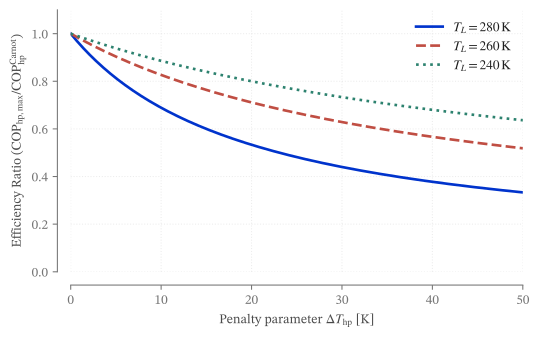
The structure of the bound becomes more clear when expressed as a ratio to the Carnot COP. Dividing Eq. \(\eqref{eq:cop_bound}\) by \(\mathrm{COP}_\mathrm{hp}^\mathrm{Carnot}\) yields \[\begin{equation} \frac{\mathrm{COP}_\mathrm{hp,max}}{\mathrm{COP}_\mathrm{hp}^\mathrm{Carnot}} = \frac{1 + \Delta T_\mathrm{hp}/T_H}{1 + \Delta T_\mathrm{hp}/(T_H - T_L)}, \label{eq:cop_ratio} \end{equation}\] which depends only on the ratio of the finite-capacity penalty to the reservoir temperature span. As \(\Delta T_\mathrm{hp} \to 0\), the ratio tends to unity. In the opposite limit, as the heating rate increases without bound, the ratio approaches \({(T_H - T_L)/T_H,}\) which is precisely the reciprocal of the Carnot COP. The best achievable heat pump in the large-capacity regime therefore becomes “as far from Carnot” as the reservoir permits, even as the absolute COP saturates at unity. The Carnot COP therefore sets both the reversible limit as capacity vanishes and, through its reciprocal, the normalized floor as finite heat transfer dominates.
This interpretation is reflected directly in Fig. 2. Each curve begins at unity in the reversible, zero-penalty limit and decays monotonically as \(\Delta T_\mathrm{hp}\) increases. The rate of decline is set by the reservoir temperature span: smaller values of \(T_H - T_L\) allow the system to retain a larger fraction of Carnot performance at a given penalty. The figure makes the central message difficult to misread. The gap to Carnot is not a consequence of component inefficiency in this idealized setting, but the unavoidable cost of moving heat at a finite rate. Treating Carnot performance as a design target obscures the tradeoff that defines practical operation: efficiency and capacity cannot be maximized simultaneously once heat exchangers are finite.
4. Optimal allocation of heat transfer capability
The COP bound depends on the exchanger capabilities \(a\) and \(b\) only through the penalty parameter \(\Delta T_\mathrm{hp}.\) For fixed inlet temperatures \(T_L\) and \(T_H\) and a prescribed heating rate \(\dot{Q}_H\), maximizing efficiency is therefore equivalent to minimizing \(\Delta T_\mathrm{hp}\), or equivalently, the total thermal resistance \({(1/a + 1/b)}.\)
This observation raises a design question. If heat exchanger capability is not free (i.e., it scales with cost, size, or weight) then increasing \(a\) and \(b\) indefinitely is not meaningful. A constraint must be imposed, and the allocation between the two sides becomes a degree of freedom. The question is: for a given total capability budget, how should it be divided between the evaporator and condenser to maximize performance?
Following Klein’s refrigeration analysis [1], the simplest constraint is adopted here: the total capability is fixed, \[\begin{equation} a + b = c \label{eq:cap_budget} \end{equation}\]
and the allocation between the two sides is to be chosen. This constraint treats capability as a resource to be distributed and simplifies the optimization problem.
Under this constraint, maximizing the bound on COP reduces to minimizing \[\begin{equation} f(a,b) \equiv \frac{1}{a} + \frac{1}{b} \label{eq:resistance_sum} \end{equation}\]
subject to \(a + b = c\) with \(a, b > 0\). Substituting \(b = c - a\) eliminates one variable and produces a single-variable problem: \[\begin{equation} \min_{0<a<c} \left[ \frac{1}{a} + \frac{1}{c-a} \right]. \label{eq:single_var} \end{equation}\]
Differentiating with respect to \(a\) and setting the result to zero gives the first-order condition, \[\begin{equation} -\frac{1}{a^2} + \frac{1}{(c-a)^2} = 0. \label{eq:first_order} \end{equation}\]
This requires the two terms to balance: \[\begin{equation} \frac{1}{a^2} = \frac{1}{(c-a)^2}. \label{eq:balance} \end{equation}\]
Taking the positive square root of both sides yields \[\begin{equation} a = c - a, \label{eq:symmetry} \end{equation}\] which immediately gives \[\begin{equation} a = b = \frac{c}{2}. \label{eq:equal_split} \end{equation}\]
To verify that this stationary point is indeed a minimum rather than a maximum or saddle point, the second derivative is evaluated: \[\begin{equation} \frac{d^2}{da^2}\left[\frac{1}{a} + \frac{1}{c-a}\right] = \frac{2}{a^3} + \frac{2}{(c-a)^3}. \label{eq:second_derivative} \end{equation}\]
Since both terms are positive for all \(0 < a < c\), the second derivative is strictly positive, confirming that the equal-split allocation is a minimum of the total resistance.
The result is specifies a simple design rule: under a fixed total capability budget, the evaporator and condenser should be sized equally.
This conclusion is worth pausing over. The useful effect of a heat pump is heat delivered on the hot side, not heat absorbed on the cold side. The condenser must reject more heat than the evaporator absorbs. One might therefore expect the condenser to warrant larger capability. The equal-allocation rule says otherwise.
The symmetry emerges because the two heat exchangers impose opposing but equivalent thermodynamic penalties. As capability shifts from one side to the other, the thermal resistance on the weakened side increases faster than the resistance on the strengthened side decreases. The minimum total resistance occurs when both sides contribute equally.
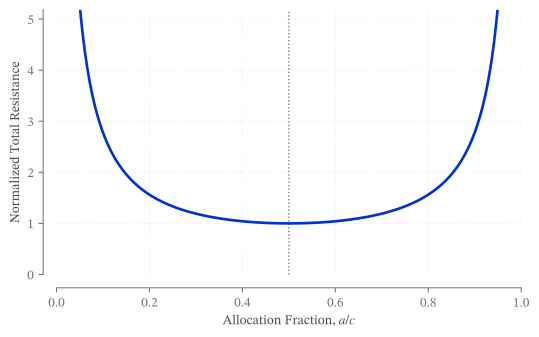
This is illustrated in Fig. 3. For a fixed capability budget \(c\), the total thermal resistance \((1/a + 1/b)\) is plotted as a function of the allocation fraction \(a/c,\) normalized by its minimum value \(4/c\) (which occurs at \(a = b\)). The curve is symmetric about \(a/c = 0.5,\) where the normalized resistance equals unity. Small deviations from the equal split impose modest penalties. But large imbalances drive the penalty steeply upward. In the limit where all capability is assigned to one side, the other side becomes a bottleneck, the normalized resistance diverges, and the achievable COP collapses to unity regardless of how large the total budget \(c\) becomes.
The practical interpretation is direct. When designing a heat pump under a fixed heat transfer budget, split the budget equally between the two heat exchangers. This rule applies regardless of the reservoir temperatures, the heating rate, or the absolute magnitude of the budget. It is a consequence of the mathematical structure of the resistance penalty and holds exactly within the assumptions of the model.
It is important to note that this result treats heat transfer capability as the constrained resource. In applications where the specific cost of achieving that capability differs significantly between the source and sink (e.g., in air-to-water systems where heat transfer coefficients vary by orders of magnitude) the economic optimum will shift away from this thermodynamic result to favor the side where conductance is more expensive to acquire.
These results also extend to more realistic models of equipment performance. Klein verified numerically that the equal-allocation rule remains approximately optimal even for realistic vapor-compression refrigerators with compressor inefficiency, throttling losses, and real refrigerant properties [1]. He found that the optimum allocation deviates from \(a = b\) by only a few percent across a wide range of compressor efficiencies and operating temperatures. This robustness makes the result directly useful for preliminary design: allocate capability equally, then refine based on detailed component analysis if necessary.
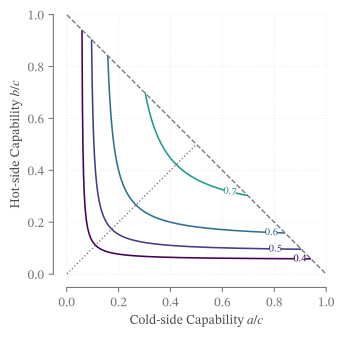
The equal-split result can be visualized another way. Fig. 4 shows contours of constant \(\mathrm{COP}_\mathrm{hp,max}/\mathrm{COP}_\mathrm{hp}^\mathrm{Carnot}\) as a function of the normalized capabilities \(a/c\) and \(b/c\). Each contour represents a level of performance relative to the Carnot limit. The dashed diagonal line represents the budget constraint \(a + b = c\), along which the sum of the two capability fractions equals unity. Points on this line correspond to different allocations of a fixed total capability.
As the allocation moves along the budget line, the performance changes. The highest COP ratio along the constraint occurs where the line crosses the \(a/c = b/c\) diagonal, where the capabilities are split equally. Movement in either direction degrades performance. Shifting capability toward the cold side (moving right along the budget line) or toward the hot side (moving left) both reduce the achievable COP ratio. The contours are tangent to the budget constraint at the equal-split point, confirming that this allocation maximizes performance for the given budget.
5. Temperature budgeting and design heuristics
Finite-capacity thermodynamics reframes heat pump efficiency as a temperature-budgeting problem: capacity consumes temperature lift, and exchanger capability buys it back.
The penalty parameter \(\Delta T_\mathrm{hp}\) has a direct physical interpretation. It represents the additional temperature lift that must be created solely to push heat through finite thermal resistances. At the Carnot limit, heat is transferred across infinitesimal temperature differences and \(\Delta T_\mathrm{hp}\) vanishes. The moment nozero heating rate is prescribed, finite approach temperatures become unavoidable and \(\Delta T_\mathrm{hp}\) becomes nonzero. The bound can then be read as a simple substitution in the Carnot-like structure: hot-side temperature \(T_H\) is replaced by \(T_H + \Delta T_\mathrm{hp}\). Part of the available reservoir span is therefore “spent” on enabling heat transfer, and only what remains contributes to useful heat elevation. Carnot performance is not a meaningful target at nonzero capacity; it is the singular limit approached only as the temperature budget allocated to finite-rate heat transfer goes to zero.
The structure \(\Delta T_\mathrm{hp} = \dot{Q}_H \left(1/a = 1/b\right)\) yields immediate design intuition. If the heating rate doubles, the temperature penalty doubles with it – capacity and efficiency are not independent knobs. If both exchanger capabilities are scaled up by a factor \(k\), the penalty drops by \(1/k\). More importantly, the reciprocal sum \(\left(1/a + 1/b\right)\) punishes imbalanced allocation. Starving one exchanger creates a bottleneck that cannot be compensated by oversizing the other, because the weak side dominates the total thermal resistance.
The bound derived here sets the maximum achievable COP when all irreversibility is confined to finite-rate heat transfer at the cycle boundaries. Internal compression and expansion are taken as reversible, and pressure drops, imperfect phase change, and other component losses are excluded. Real vapor-compression cycles incur additional irreversibilities in the compressor, expansion device, and piping, and these losses are not captured by \(\Delta T_\mathrm{hp}\). The bound therefore sits between the Carnot limit and real performance: tighter than Carnot because finite heat transfer is accounted for, yet optimistic because component inefficiency is ignored. If a heat pump operating under given conditions falls well below the finite-capacity limit, the shortfall must be attributed to compressor losses, throttling, pressure drop, maldistribution, or heat exchanger design shortcomings rather than to fundamental thermodynamic constraints. The cost of moving heat at finite rates is separated cleanly from everything else.